



1. What is Maslow's Hierarchy of Needs?
Maslow's hierarchy of needs is a theory of motivation in psychology that includes a five-tiered model of human needs: biological, safety, social, esteem, and self-actualization.
Maslow's theory was introduced in 1943 by psychologist Abraham Maslow in his article "A Theory of Human Motivation.".
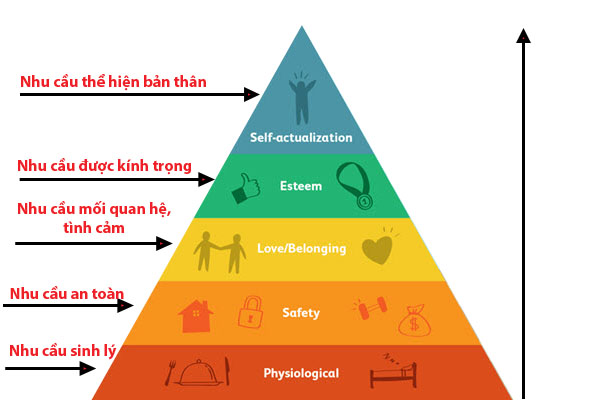
Maslow's hierarchy of needs has a profound influence due to its applicability across all fields, especially in management, including human resource management, marketing management, and training. Furthermore, Maslow's hierarchy of needs is also used to explain several phenomena in life.
2. The significance of Maslow's hierarchy of needs in life
According to the humanistic psychologist Abraham Maslow, humans have many needs, which are categorized into different levels. These include basic needs and higher-level needs. According to common theory, people usually prioritize basic needs before higher-level needs arise.
Basic needs here include eating, sleeping, and physiological needs, all of which are indispensable for a human being. Only then come the needs for safety, connection, and self-expression at higher levels.
3. The 5 levels of Maslow's hierarchy of needs
Level 1: Basic Needs
This is the most basic need, present in everyone and serving as the foundation for the development of subsequent needs. In business, the needs corresponding to Maslow's first level of needs include essential needs such as food, rest, etc.
Level 2: Safety needs
This is considered a higher level of basic needs. It includes the desire for physical protection, job security, shelter, etc. In business, the second level of Maslow's hierarchy of needs means your business must ensure commitment and sustainability. This means consistently doing what the business promises, building trust with customers.
Level 3: Social needs – connection
This is a need that leans towards emotional and spiritual factors. Accordingly, people always want to be in social relationships such as family, school, company, etc. Applying this to business operations, companies need to ensure personalization for customers, appreciate their support for the business, and show concern for their individual needs…
Level 4: Esteem needs
This is a need to express the desire to be liked and respected within an organization and society. Similarly, in business, companies must give customers the feeling of being valued, receiving special attention, and being treated kindly and courteously, demonstrating that "the customer is king.".
Level 5: Self-actualizing needs
This is the highest need in Maslow's hierarchy of needs. It is the desire for self-expression, self-affirmation in life, to live and work according to one's interests and passions, and to contribute to the community.
In business, the fifth level of needs corresponds to customers feeling confident in themselves, feeling that their decision to purchase goods or services from the business is the right one, and feeling important not only to the business but also to everyone else around them in their lives.
Maslow's hierarchy of needs explains why some businesses fail to truly meet customer service needs if they focus only on higher-level needs or ignore the most basic needs.

4. Applying Maslow's Hierarchy of Needs in Management & Marketing
4.1 Application of Maslow's Hierarchy of Needs in Management
Maslow's hierarchy of needs applied in the company.
– Basic needs: Employees should be paid a fair and deserving salary by the company, based on their position and abilities. This salary should also cover minimum expenses and include additional allowances such as transportation and lunch money, along with a suitable work and rest schedule.
– Safety requirements: The company must ensure good working conditions for its employees. This is demonstrated through the signing of labor contracts and compliance with legal regulations regarding social insurance, health insurance, and unemployment insurance for employees.
– Social needs: According to Maslow's hierarchy of needs, meeting social needs in management is demonstrated through building a team-oriented work culture, forming unions, departmental divisions, etc. In addition, it is necessary to organize quarterly or annual trips, team-building activities, or extracurricular events for staff and employees on a departmental or company-wide scale.
– The need for respect: In the workplace, there should be clear career progression paths for employees in terms of both salary and position. Empower each employee with responsibility and implement fair reward and punishment systems to motivate them.
– The need for self-expression: Leverage and provide opportunities to develop the strengths of each individual in the company. Consider leadership positions for the best performing employees. Empower employees to have a voice and contribute to the company's development.
4.2 Maslow's Hierarchy of Needs as Applied in Human Resource Management
The reality is that every employee working at a company simultaneously has all five of these needs. Therefore, managers need to have appropriate policies for each individual at different times.
For example: For a recent graduate, their immediate needs are a suitable job with a salary sufficient to cover their living expenses and opportunities to gain more work experience. The company needs to create conditions and arrange work and positions that are appropriate to these needs of the employee;
As for employees with long-term experience, the company must consider other factors that suit them, such as their desire for promotion, their need for a better salary and benefits package, and their need to speak at important meetings, etc.
In reality, many companies, despite offering very high salaries, still struggle to retain employees, especially talented individuals. This situation may be due to employees not being able to work in roles that match their strengths, or not feeling valued, and their opinions and positions not being respected within the company.
Therefore, human resource managers need to understand Maslow's hierarchy of needs in order to manage more intelligently, skillfully, and effectively.
4.3 Maslow's Hierarchy of Needs in Marketing
The levels in Maslow's hierarchy of needs represent all the purchasing needs of consumers. Therefore, once businesses understand the psychology and purchasing behavior of customers, they can easily reach customers and communicate effectively.
Applying Maslow's hierarchy of needs to identify customers.
Identify which level of needs your customers belong to in Maslow's hierarchy.
Is the proportion of your customers who fall into that need group widespread or just a small segment?
At what level of the hierarchy of needs do your products and services meet?
Applying Maslow's hierarchy of needs in communication.
Once the target customers have been identified, businesses need to plan the right approach and communication strategy:
– Communication channels: Businesses need to choose the most effective communication channels based on the characteristics of their customer groups at each level of need. Typically, for basic needs, businesses often use television advertising.
Therefore, the wider the communication, the more effective it is. However, many businesses also choose a specific approach to customer outreach based on customer needs. For example, Lamborghini and Vertu often use data purchased from banks and choose to market directly to high-income customers or those with large account balances. .
– Communication message: According to Maslow's hierarchy of needs in Marketing, the communication message must address the needs and interests of customers. The company's products and services must be persuasive enough to satisfy those needs.
In summary, each of us possesses all five levels of needs in Maslow's hierarchy. Understanding customer needs and purchasing power is key to giving businesses a competitive advantage in the fierce marketplace.
Source: bstyle
Author: Pham Phan - Date written: June 25, 2020
Category: Uncategorized

0 thoughts on “Ứng dụng tháp Maslow trong quản trị và marketing”