




This article is from Ms. Phoenix Ho – Career Counseling Specialist – Hon Viet Psychological Counseling Center. Today, the admin is reposting it as a gift to those of you who are wondering about your own career path.
Career development path – will you choose vertical or horizontal?
The other day, a former student confided in me about her dilemma, saying:
- After graduating and starting work in my field, I like working in one position to learn a little, and once I've learned a decent amount, I like to switch to another position to learn a little more.
- At each stage, I find myself learning new knowledge and gaining work experience, but I haven't yet felt the urge to delve deeply into any particular subject.

- I still really enjoy this nomadic lifestyle, but I'm also scared because when I look around at my friends who have been in one position for a long time, they get promoted and get paid higher salaries, while my salary and position remain the same as when I first started in the industry.
I shared with her that in career guidance there's a concept called vertical or horizontal development, and I used the diagram below to help her understand what I meant.
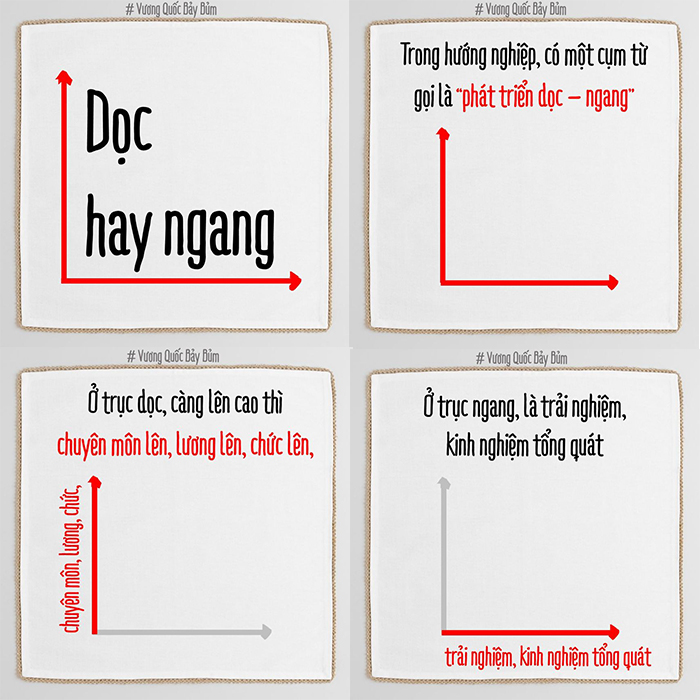
VERTICAL AND HORIZONTAL CAREER DEVELOPMENT CHARTS
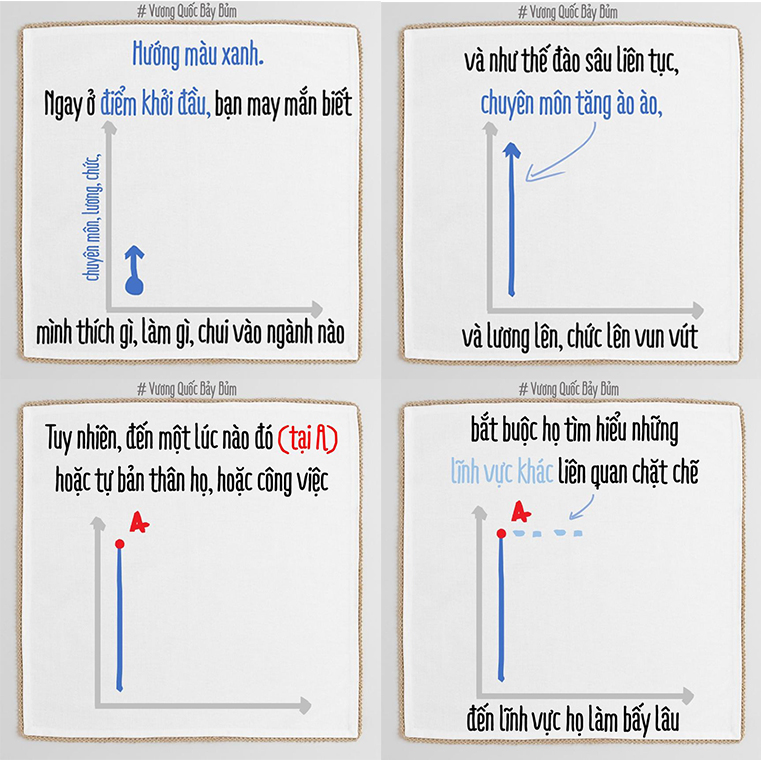
Imagine this chart represents a person's career development within a particular profession. Some individuals (the blue line) know from the start which area of that profession they want to develop in, and they continue to delve deeper, learn, and gain experience and knowledge in that area. This is an example of someone who will develop their career vertically. As a result, their promotions and salary increases will be directly proportional to the time and effort they invest in that area.
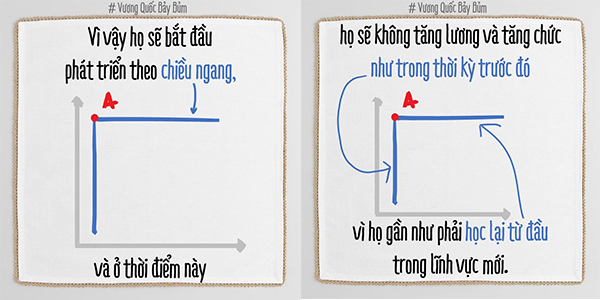
At some point (at point A), either by themselves or due to work requirements, they will explore other fields closely related to their long-standing expertise. Therefore, they will begin to develop horizontally, learning new skills and gaining experience.

At this point, they won't receive salary increases or promotions like in the previous period because they almost have to start learning from scratch in the new field. Unlike the blue line, there will be people (the orange line) who, from the beginning, didn't know which area of their profession they wanted to develop in, and so they experienced, learned, and worked in one field after another. They liked a little bit of everything, and their knowledge and experience developed more broadly than deeply. This is an example of someone who will develop their career horizontally. As a result, their overall experience, knowledge, and expertise in the industry will grow over time, but their position and salary will remain almost the same. At some point (at point B), they realize which area they are most interested in or best suited for career development.

They begin to focus their time and effort on that area. Thanks to their general knowledge and accumulated experience, they get promoted and receive salary increases very quickly from this point on. There will also be people (two pink lines) who take a different, somewhat zigzag path, falling somewhere between the two cases above.

But no matter which path they take, after a certain period of time, all paths will converge at point C, where they achieve similar salaries, possess comparable professional knowledge, and hold relatively similar job positions.


Based on this chart, I advise her that the key to career development is:
- Clearly understand which color path you are pursuing, the reasons behind it, its strengths and weaknesses, and the gains and losses of that decision. Then, when making a decision, avoid making unreasonable comparisons with the other two colors.
- Don't share too much of your intentions with your parents if you think they might not understand. In other words, only share what they can understand to reassure them. Keep the rest of the information to yourself, share it with friends who can understand, or see a professional like me, for example. :)
- Compare yourself to yesterday rather than to others, because they may be taking a different path than you.

Conclude This is just a concept I use to help you better understand your career development in your early years. It's not all-encompassing, and it's not simply a matter of three different colored paths meeting at a common point, because a person's career development is influenced by many different factors that this chart doesn't account for. The important thing is that you always take action, and following that action is reflection on your actions. Balancing these two things will help you a great deal. Never stand still and do nothing, blaming circumstances or others. If you can do this, you'll be fine.
Love.
Author: Ms. Phoenix Ho
Painting: The Kingdom of Seven Farts
Author: Pham Phan - Date written: December 26, 2018
Category: Student life, News - Events

0 thoughts on “Con đường phát triển nghề nghiệp – bạn chọn dọc hay ngang?”