




According to statistics, the employment rate in 2018 reached 98%, but the quality of the workforce remains quite limited.
According to information presented at the recent national forum "Improving Vietnamese Labor Skills," Mr. Nguyen Van Cuong, Deputy Director of the General Affairs Department, Office of the Central Committee of the Communist Party of Vietnam, stated that the employment rate accounts for a high proportion of the total workforce and is trending upwards rapidly with the development of the economy.
The quality of the workforce is not yet high.
In 2000, the employment rate for those aged 15 and over accounted for approximately 96.21% of the total labor force. This rate was maintained for over 10 years (from 2000 to 2010) and increased to approximately 981% from 2011 to the present.
In 2016, the employment rate was 97.91 TP3T; in 2017 it was 97.961 TP3T; and in 2018 it reached 981 TP3T.
However, the number of workers who are business owners and salaried employees accounts for only about 441% of the total employed workforce, although this percentage has increased annually.
Self-employed and family-employed workers account for approximately 561% of the total employed workforce.
This partly reflects the limited quality of employment for Vietnamese workers, with a high percentage of the workforce employed in the informal sector.
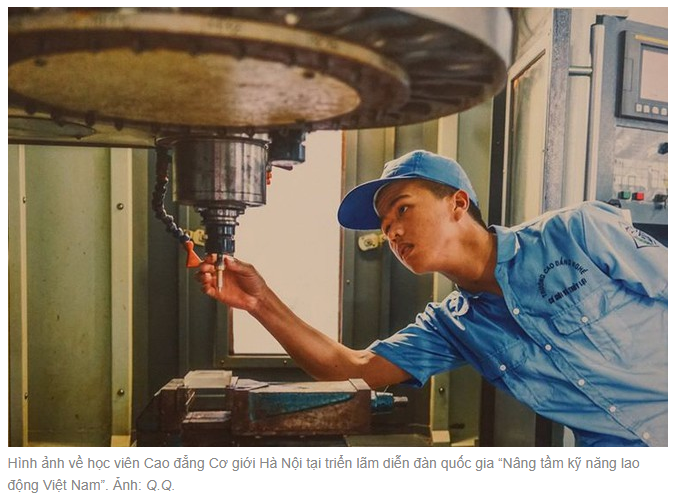
According to Ms. Vi Thi Hong Minh, Deputy Director of the Employers' Office – Vietnam Chamber of Commerce and Industry (VCCI), if comparing the results of businesses' assessments of vocational education quality among provinces in 2017, Da Nang had the highest percentage of businesses giving positive ratings, reaching 55.21 TP3T. Long An ranked next (51.61 TP3T) and Dong Thap (51.21 TP3T).
These are the 3 provinces with over 501 businesses rating vocational education as good.
Conversely, Dien Bien (20.61 TP3T) and Yen Bai (24.71 TP3T) are the two provinces with the lowest percentage of businesses giving positive feedback on the quality of vocational education and training, reaching less than 1/4 of the total number of businesses.
The two major economic and educational centers of Vietnam, Ho Chi Minh City and Hanoi, both have business ratings of 40.6% and 32.5% respectively, ranking 22nd and 45th out of 63 provinces and cities.
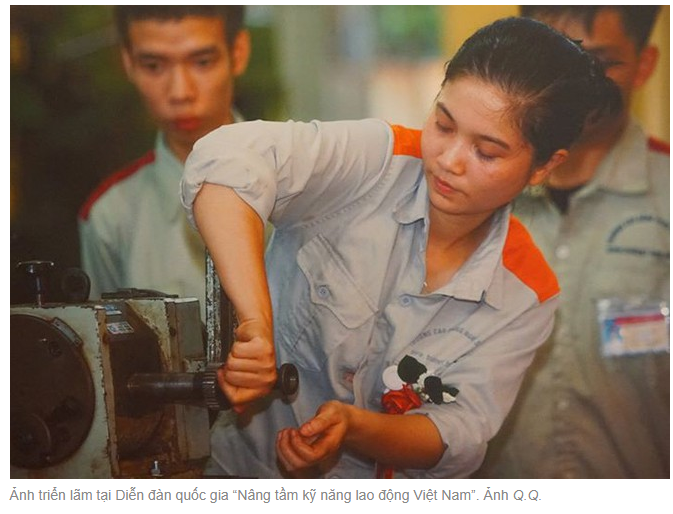
Businesses must collaborate with vocational schools.
To improve the quality of the workforce, according to the World Bank, most employers report that recruitment is difficult because candidates lack skills or there is a shortage of workers in certain professions.
Unlike many other countries in the world today, Vietnam does not face labor shortages, but businesses find it difficult to find workers with the right skills.

The World Bank argues that businesses and vocational education institutions need to build close partnerships. Parents need to be more involved in their children's education. Students need to gain practical work experience before graduation.
Mr. Nguyen Van Cuong believes that Japan's greatest success in human resource development is the training of technical workers within companies. In Japan, the majority of workers are trained in this way. When workers join the "company family," they are trained to become true employees of the company, both in terms of work skills and lifestyle.
The company's training process takes place in two phases. Phase one focuses on work ethic, practical skills, and corporateization. Phase two involves professional training through formal and informal on-the-job training.
In this context, formal on-the-job training ensures that workers are trained according to official programs and evaluated according to unified standards.
Informal on-the-job training is considered more important because it allows for continuous and lifelong training and skill development for workers.
Source (https://news.zing.vn/98-lao-dong-co-viec-lam-nhung-chat-luong-con-han-che-post1013909.html?fbclid=IwAR2o3ZK1Bz8TQU5xE1RUE7CnhUkw41Dw6EThux1_MilXB8Kci_4ltnyYP40)
——————–
Detailed information American Polytechnic College (APC):
Zhongshan Campus:
- Address: Numbers 5-7-9-11, Street No. 4, Trung Son Residential Area, Ho Chi Minh City
- Phone: (028) 5433 6888
- Hotline: 0938 90 5050 | 090 2858 550
Go Vap branch:
- Address: 1A Nguyen Van Luong Street, Ward 6, Go Vap District, Ho Chi Minh City
- Phone: (028) 7302 5888
Cu Chi branch:
- Address: 83A Bui Thi He Street, Ward 1, Cu Chi Town, Cu Chi District, Ho Chi Minh City
- Phone: (028) 3636 4983
Can Tho branch
- Address: 135P Tran Hung Dao Street, An Phu Ward, Ninh Kieu District, Can Tho City
- Phone: (0292) 3832 045
- Hotline: 0937 910 212
Training programs/fields of study:
UK INTERNATIONAL COLLEGE SYSTEM:
- BTEC HND in Hospitality Management
- BTEC HND in Business (HRM – Human Resource Management)
- BTEC HND in Business (Marketing)
- BTEC HND in Business (Accounting and Finance)
- BTEC HND in Art and Design
REGULAR COLLEGE PROGRAM:
- Management group
- Translation and Interpretation Group
- Information Technology Sector
- Healthcare sector
- Design field
Facebook: American Polytechnic College
E-mail:
- Admissions Office: info@caodangvietmy.edu.vn
- Training Department: phongdaotao@caodangvietmy.edu.vn
- Student Services Office: dichvusinhvien@caodangvietmy.edu.vn
Author: Viet My College - Date written: November 21, 2019
Category: Job opportunities, Career information, News - Events
Tags: American Polytechnic College, choosing a career, Job opportunities, Viet My College

0 thoughts on “98% lao động có việc làm nhưng chất lượng còn hạn chế”