



Where is the best place to start when talking about “sustainable fashion”? Schools, of course.

The fashion industry is one of the biggest contributors to environmental pollution. This isn't new news, but companies are trying to address the problem. A prime example is fashion schools.
In a country like the Philippines, where plastic waste pollution ranks third in the world after Indonesia and China, it's no surprise that schools feel a responsibility to engage in sustainable fashion. Fashion schools such as the Institute for Creative Entrepreneurship: Fashion, Art and Design (ICE-FAD) and the College of Fine Arts and Design at the University of Santo Tomas (CFAD-UST) have already taken steps toward this responsibility.
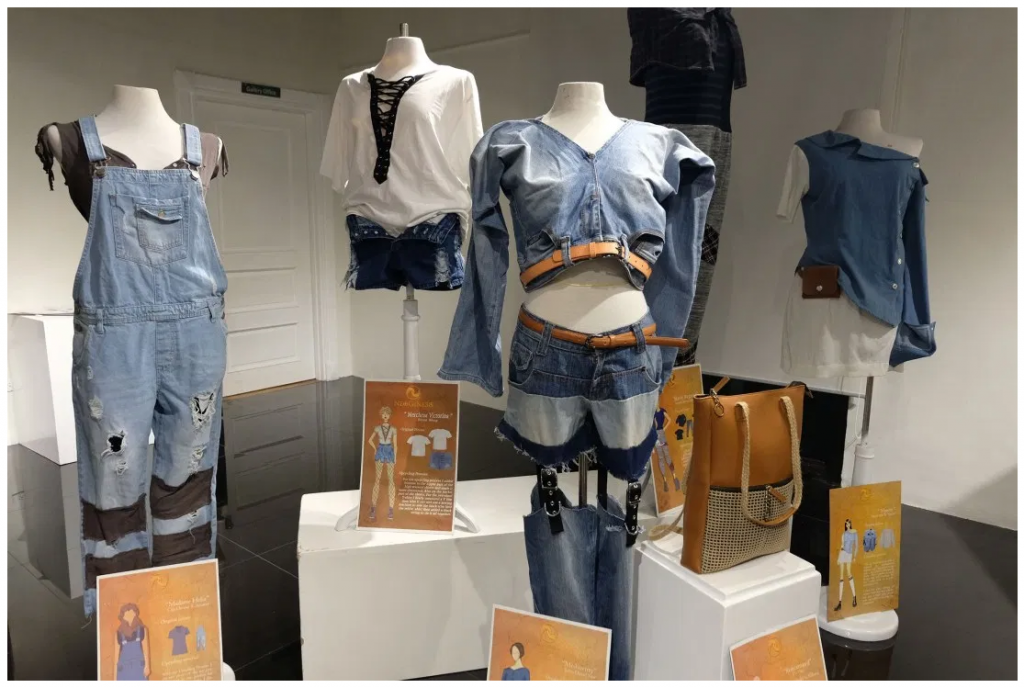
On September 28th, ICE-FAD introduced a new generation of design talent. They received training in sustainable fashion through recycling, with "circular economy" being one of the methods they introduced to their students.
In the competition, each piece of fabric was made by cutting and/or reusing old clothes. Most were hand-sewn by students with guidance and support from teachers from ICE-FAD.
Irene Grace Subang, a fashion instructor, said: ”As a teacher and designer, I believe it is my responsibility to educate my students about the global pollution that the fashion industry is causing. Let's experiment together with sensible methods that can lead to long-term sustainability, and encourage them to overcome challenges with me as sustainable fashion warriors.”

Irene has given lectures on sustainable fashion at schools like ICE-FAD and the SoFA design institute, among others. The challenge she faces is that clothing is still produced using traditional methods; the concept of sustainable fashion remains elusive for most designers, manufacturers, and factories. To address this challenge, she has to engage her students with videos and workshops about sustainability and the cost of global pollution caused by the fashion retail segment.
Waste is inevitable, but she encourages them to repurpose discarded items into something beautiful. For example, "True Cost," one of the documentaries she shows in her class, summarizes all the wrong things about how we consume and produce clothing.
Monina Tan-Santiago, CEO of ICE-FAD, shared her thoughts on why ICE-FAD is incorporating sustainable fashion into its curriculum. She stated, “We decided to include sustainability in our curriculum because ICE believes that to help address or mitigate the ecological crisis, we should start with education.”.
“As educators in the fashion industry, we believe we have a responsibility to teach designers and entrepreneurs about their role in reducing carbon emissions to ensure a sustainable future for generations to come.”.

However, Monina stated that the fashion industry in the Philippines, not just designers and students, needs to embrace sustainable fashion practices. She added, “The availability and cost of sustainable fabrics is also one of the challenges we face.”.
Meanwhile, Reah Benedicta Goodwin, a university lecturer at CFAD-UST, has also championed the concept of sustainable fashion at her own university. “I saw firsthand how wasteful this industry was when I worked in Los Angeles many years ago. Back then, very few people or organizations cared about sustainability or ethics in the fashion industry. That was also the heyday of fast fashion, so consumers cared more about trends, quantity, and variety.”.
She added:“When I returned to the Philippines, I saw a massive influx of secondhand shops, and I finally realized where they came from. At that time, I was reusing a lot of my clothes.”
“I had the opportunity to interrupt a recycling concept presentation while attending a freelance fashion event at UST CFAD. I found it to be a fantastic gathering to teach our students how to become responsible designers by not only focusing on the aesthetics of design but also on the impact of the materials used in product manufacturing on the environment and people.”
Like most instructors at ICE, Reah says teaching the concept of sustainable fashion isn't without its challenges. She explains, "Time is my biggest hurdle." Both the time to teach such a large concept and the time to monitor whether what I teach is sufficient for the students to apply in practice (reuse is a prime example). As an instructor, I measure the success of a lesson not just by grades, but by how our students apply that lesson in real-world situations.
Source (https://the-inkline.com/2019/10/14/how-fashion-teachers-in-the-philippines-are-talking-about-sustainability/?fbclid=IwAR0toofEyYJWL_h-rUYW-dqeCXGXyhud4c3Z2wenw7-DgCitXsWd-ugc2i0)
——————–
Detailed information American Polytechnic College (APC):
Zhongshan Campus:
- Address: Numbers 5-7-9-11, Street No. 4, Trung Son Residential Area, Ho Chi Minh City
- Phone: (028) 5433 6888
- Hotline: 0938 90 5050 | 090 2858 550
Go Vap branch:
- Address: 1A Nguyen Van Luong Street, Ward 6, Go Vap District, Ho Chi Minh City
- Phone: (028) 7302 5888
Cu Chi branch:
- Address: 83A Bui Thi He Street, Ward 1, Cu Chi Town, Cu Chi District, Ho Chi Minh City
- Phone: (028) 3636 4983
Can Tho branch
- Address: 135P Tran Hung Dao Street, An Phu Ward, Ninh Kieu District, Can Tho City
- Phone: (0292) 3832 045
- Hotline: 0937 910 212
Training programs/fields of study:
UK INTERNATIONAL COLLEGE SYSTEM:
- BTEC HND in Hospitality Management
- BTEC HND in Business (HRM – Human Resource Management)
- BTEC HND in Business (Marketing)
- BTEC HND in Business (Accounting and Finance)
- BTEC HND in Art and Design
REGULAR COLLEGE PROGRAM:
- Management group
- Translation and Interpretation Group
- Information Technology Sector
- Healthcare sector
- Design field
Facebook: American Polytechnic College
E-mail:
- Admissions Office: info@caodangvietmy.edu.vn
- Training Department: phongdaotao@caodangvietmy.edu.vn
- Student Services Office: dichvusinhvien@caodangvietmy.edu.vn
Author: Viet My College - Date written: December 2, 2019
Category: College 9+, Fashion design, News - Events
Tags: American Polytechnic College, fashion design, Viet My College

0 thoughts on “Cùng gặp gỡ Filipino – giảng viên ngành Thiết kế thời trang để tìm hiểu về Thời trang bền vững”